Who would have thought you could make a pavlova without sugar? This is the perfect sugar-free, low-carb dessert for the festive season — crisp on the outside, marshmallowy in the middle, and nobody will guess there is no sugar in it.
It works as a traditional round pavlova or as a Christmas wreath. Both are covered below.
Before you start — five things that make the difference
Sugar-free meringue is less forgiving than the regular kind. These five points are the difference between a pavlova and a puddle.
1. Your bowl must be spotless. Wipe it out with paper towel dipped in vinegar before you start. Any trace of grease will stop the egg whites whipping up properly.
2. Oil your baking paper. Spray or wipe it with a little coconut or olive oil. Sticking is the most common failure with a sugar-free pav, and this solves it.
3. Use cream of tartar as your stabiliser. We have tested vinegar, cream of tartar and xanthan gum — cream of tartar wins comfortably. Skip the xanthan gum entirely; it caused more failures than successes.
4. Bake low. Lower than you think. At 120°C fan-forced it still browns too much. Aim for 100–110°C. Every oven differs, so watch it and drop the temperature if it colours too quickly.
5. Powder your sweetener. Granulated erythritol will not dissolve fully into the egg whites and you will get a gritty texture. Blitz it to a powder first, or buy it powdered.
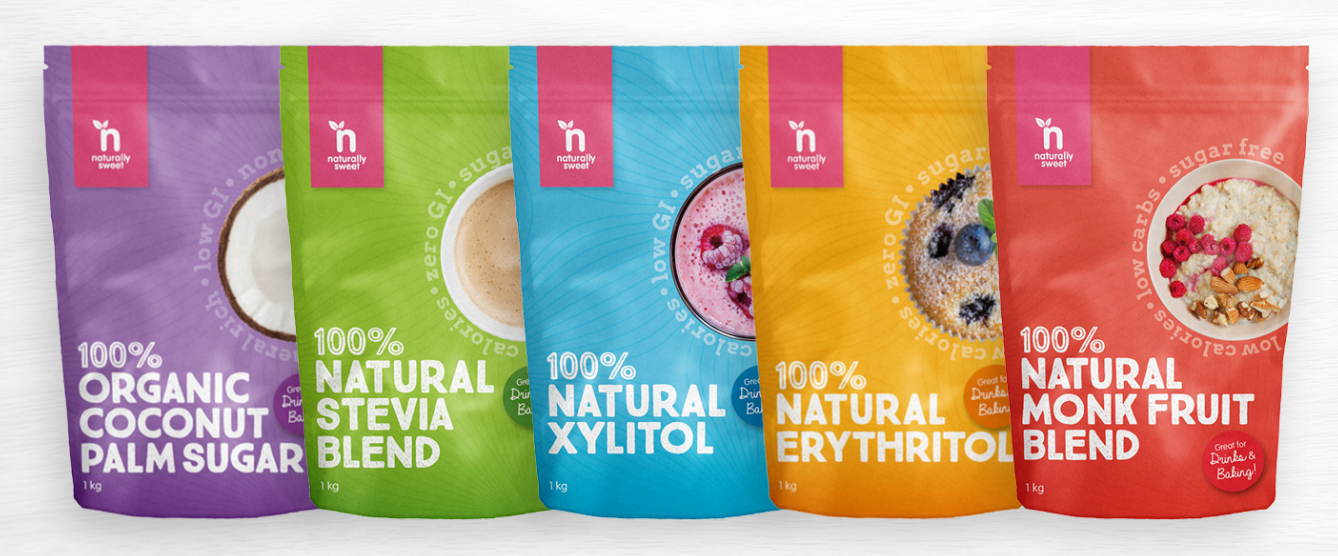
A note on our Stevia Blend. Our Stevia Blend is five times sweeter than sugar — it is not a spoon-for-spoon replacement. Where this recipe uses it, the quantities are already adjusted. Our Monk Fruit Blend is a 1:1 replacement. See the conversion chart if you are swapping anything.
Ingredients
For the pavlova
- 5 large egg whites
- 1 teaspoon cream of tartar
- ½ cup erythritol, powdered
- 1 teaspoon vanilla extract
For the berry coulis (optional)
- 1½ cups raspberries, strawberries or blackberries
- ¼ cup water
- 1 teaspoon stevia blend, or 1 tablespoon monk fruit blend
To serve
- 1 cup pure cream, whipped with 1 teaspoon vanilla extract and 1–2 teaspoons stevia blend (or 1–2 tablespoons monk fruit blend)
- 1–1½ cups fresh berries
- Mint or basil leaves, to garnish (optional)
Prep 10 minutes · Bake 90 minutes · Serves 12
Method
Make the pavlova
- Preheat the oven to 150°C fan-forced.
- Draw your shape on the back of a sheet of quality baking paper — a 20cm circle for a round pavlova, or a 25cm outer circle for a wreath. Turn the paper over and wipe or spray it lightly with oil.
- Wipe out a large mixing bowl with paper towel dipped in vinegar.
- Add the egg whites and cream of tartar. Whisk on high until firm peaks form.
- Add the powdered erythritol one tablespoon at a time, whisking well between each addition.
- Add the vanilla and continue whisking until the mixture is thick and glossy — about 3 to 5 minutes. Stop as soon as it turns glossy or you risk over-mixing.
- Spoon the meringue onto the baking paper and shape with a knife or spatula. Pull up little peaks with the edge of the blade, or leave it smooth.
- Turn the oven down to 100°C fan-forced.
- Bake a round pavlova for 90 minutes, or a wreath for about 60 minutes, until crisp and dry to the touch.
- Turn the oven off, open the door slightly, and leave the pavlova inside until completely cool. Do not rush this — cooling it too fast will crack it.
- Top with whipped cream, berries and leaves. Drizzle with coulis if using.
Make the berry coulis
- Put the berries, water and sweetener in a saucepan. Bring to the boil, then reduce to a simmer for about 5 minutes, stirring regularly — the mixture catches easily.
- Mash any larger pieces with a fork and allow to cool before spooning over the pavlova.
If you want to strain out the seeds, wait until it has cooled. Strawberries break down more slowly than raspberries, so chop them small before cooking. Blending gives a smoother sauce, which works especially well with strawberry.
Variations
Using a monk fruit blend instead. Swap the erythritol for about ⅓ cup of monk fruit blend. Powder it first, exactly as you would the erythritol. It is a 1:1 sugar replacement, so it brings both the sweetness and the bulk the meringue needs.
Why not stevia blend in the shell? Because our Stevia Blend is five times sweeter than sugar, the quantity you would need — about a tablespoon — is nowhere near enough solid material to build a meringue. Sweetener is doing structural work here, not just flavour. Keep the erythritol or monk fruit blend for the shell, and use stevia blend in the coulis and the cream, where bulk does not matter.
Using xylitol. Xylitol also works in meringue. Use ¾ to 1 cup of xylitol in place of the erythritol, again powdered, and add a teaspoon of vinegar with the vanilla. A xylitol pavlova browns a little more readily, so keep the oven at the lower end of the range. Note: xylitol is toxic to dogs — keep it well away from pets.
A bigger pavlova. You can go up to 7 egg whites. The quantity of cream of tartar given will hold them.
Recipe notes
Sugar-free pavlovas soften faster than sugar ones, so they are best eaten the day they are made. If you need to get ahead, bake the shell the night before and leave it in the switched-off oven overnight, then decorate just before serving.
Per serve: 102 kcal · 2.1g carbohydrate · 1.6g protein · 9.2g fat
What to use
- Erythritol — our pick for the meringue shell. Clean taste, no aftertaste, whips in well once powdered. Use about a third more than you would sugar.
- Monk Fruit Blend — a 1:1 sugar replacement with no bitterness. The best alternative for the shell.
- Stevia Blend — five times sweeter than sugar, so use one fifth as much. Ideal for the coulis and the cream, not for the shell.
- Xylitol — works well in meringue if it is what you have on hand.
Not sure how much to use? Our conversion chart has the exact ratios for every product we sell.
Recipe developed in partnership with Karen from ketohh — follow @alowcarblowsugarlifestyle for more low-carb baking.