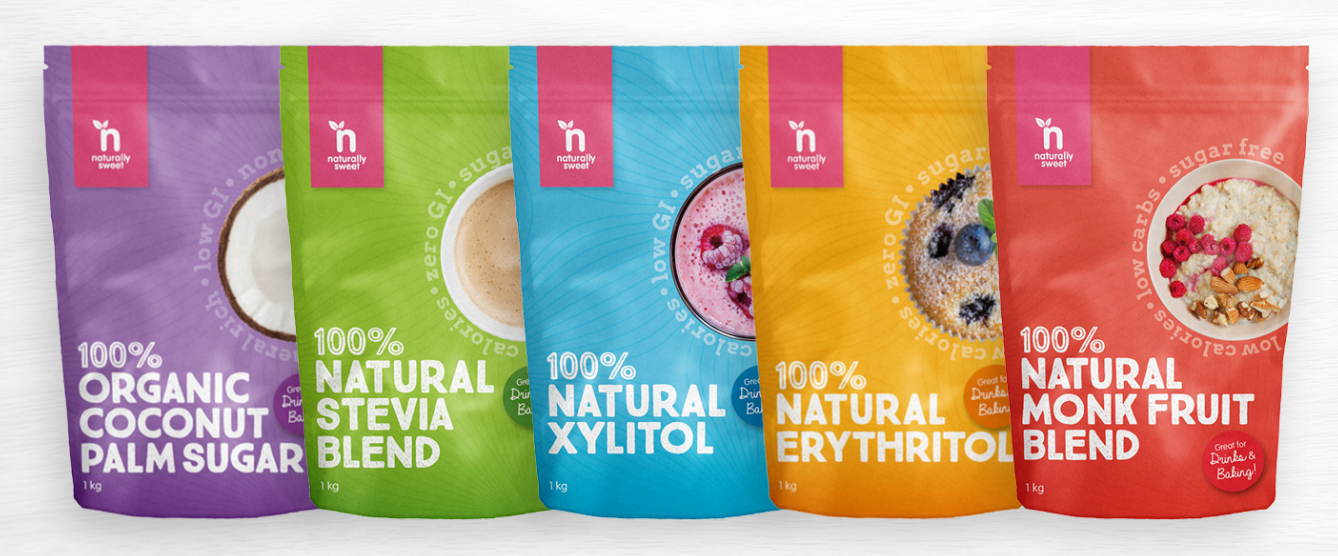
If you have been told to cut back on sugar, the sweetener aisle is confusing. Some products claim to be "diabetic friendly." Others carry warnings. The nutrition panel on a bag of erythritol says it is almost entirely carbohydrate, which seems to defeat the point entirely.
This guide sets out what the Australian and international health bodies actually say, what the labels mean, and where the evidence is genuinely unsettled. We sell sweeteners, so we have been careful to link every factual claim to its source so you can check it yourself.
Key facts
- Diabetes Australia's position is that alternative sweeteners are not essential for people living with diabetes, but that some people may choose to use ones approved by FSANZ.
- Intense sweeteners (steviol glycosides, monk fruit extract, sucralose, aspartame) do not raise blood glucose.
- Sugar alcohols (erythritol, xylitol, maltitol, sorbitol) behave differently from each other. Xylitol and maltitol are partly absorbed and can affect blood glucose. Erythritol is largely not absorbed.
- The WHO's 2023 recommendation against non-sugar sweeteners for weight control explicitly excludes people with pre-existing diabetes, and does not apply to sugar alcohols at all.
- No sweetener treats or manages diabetes. Replacing sugar is one small part of a plan you should set with your GP, endocrinologist or credentialled diabetes educator.
What the Australian guidance actually says
Diabetes Australia divides the field into two groups. On alternative sweeteners it says non-nutritive sweeteners, a category that includes stevia, "do not have an effect on blood glucose levels and may be a useful alternative for replacing added sugar."
Sugar alcohols get a more cautious treatment. Diabetes Australia notes they are carbohydrates that "can contain as many kilojoules (kJ) as sugar and may have an effect on blood glucose levels," and that eating too much "can have a laxative effect."
The framing they use is worth repeating, because it is more honest than most marketing: alternative sweeteners are "not essential for people living with diabetes, however some people with diabetes may still choose to use alternative sweeteners" that FSANZ has approved as safe.
That is the correct starting point. A sweetener is a substitution tool, not a treatment.
What is approved in Australia
Food Standards Australia New Zealand assesses every sweetener before it can be sold here, and sets an Acceptable Daily Intake for most of them. The approved intense sweeteners are:
| Sweetener | Additive number | ADI (mg per kg body weight per day) |
|---|---|---|
| Steviol glycosides (stevia) | 960 | 0–4 |
| Monk fruit extract | — | Not set — no safety issues identified |
| Sucralose | 955 | 0–15 |
| Aspartame | 951 | 0–40 |
| Acesulphame potassium | 950 | 15 |
| Saccharin | 954 | 0–5 |
FSANZ completed a review of these sweeteners and found "no public health and safety issues" with the approved list.
One detail specific to Australia catches people out. The approved sweetener here is the food additive steviol glycosides (960), and it carries a purity specification: FSANZ notes the JECFA standard requires purity of "no less than 95% total steviol glycosides on the dried basis." Raw green stevia leaf contains only a small fraction of that, so it cannot be sold here as additive 960. This is why every legitimate Australian stevia product is a white powder or a blend rather than a green one. We covered it in detail in our guide to white versus green stevia.
The two groups behave very differently
Intense sweeteners: no effect on blood glucose
Steviol glycosides, monk fruit extract, sucralose and aspartame are used in tiny quantities because they are hundreds of times sweeter than sugar. The Food Standards Code describes steviol glycosides as approximately 150 to 300 times sweeter than sucrose. At those quantities they contribute no meaningful carbohydrate and do not raise blood glucose.
In practice you will rarely buy these on their own for baking, because a few grams sweetens a whole cake and you are left with no bulk. Most retail products are blends — a small amount of the intense sweetener carried in erythritol, so you can measure it with an ordinary spoon. That means when you buy a "stevia blend" or a "monk fruit blend," the ingredient you are eating most of is the erythritol.
Blends are not all the same strength — check the pack before you substitute. Our Monk Fruit Blend replaces sugar 1:1, but our Stevia Blend is five times sweeter than sugar, so you use one fifth as much. Getting this wrong is the single most common reason a sugar-free recipe comes out inedible. Our conversion chart has the exact quantities.
Sugar alcohols: it depends entirely which one
This is where "sugar alcohol" as a single category becomes unhelpful, because the members are not interchangeable.
Erythritol is absorbed in the small intestine and then excreted largely unchanged in urine rather than being metabolised. That is why it contributes very little energy and has minimal effect on blood glucose. It is also why it is gentler on the stomach than most polyols at moderate doses — it is absorbed before it reaches the large intestine, where the others ferment.
Xylitol is different. It is partly metabolised, carries roughly two thirds the kilojoules of sugar, and has a measurable glycaemic effect — smaller than sugar, but not zero. If you are counting carbohydrate, xylitol needs to be counted. It also ferments in the large intestine, so it causes bloating and a laxative effect more readily than erythritol does.
Maltitol and sorbitol are the ones that most often appear in commercial "sugar free" chocolate and lollies, and they have the largest glycaemic effect of the common polyols. If a sugar-free product has surprised you with a blood glucose rise, check whether maltitol is on the ingredient list.
Xylitol and dogs. Xylitol is severely toxic to dogs even in small amounts. If you have a dog in the house, store it out of reach and be careful with baked goods left on benches. Erythritol does not carry this risk.
What the WHO said in 2023, and what it did not say
In May 2023 the World Health Organization released a guideline that recommends against using non-sugar sweeteners to control body weight. The headlines were blunt and a lot of people with diabetes read them and threw out their sweeteners.
Three things in the guideline itself are worth knowing before you do that.
It excludes people with diabetes. WHO states the recommendation "applies to all people except individuals with pre-existing diabetes."
It excludes sugar alcohols. The guideline explicitly does not apply to "low-calorie sugars and sugar alcohols (polyols)" — so erythritol and xylitol are outside its scope entirely.
It is a conditional recommendation. WHO classifies it as conditional, meaning the evidence base was not strong enough for a firm one, and that "policy decisions based on this recommendation may require substantive discussion in specific country contexts."
None of that makes the guideline irrelevant. Its underlying point — that swapping sugar for sweeteners does not by itself produce long-term weight loss — is a reasonable read of the evidence and a useful corrective to marketing. But it was not a warning aimed at people managing diabetes, and it was not about the polyols most Australian baking sweeteners are built on.
The erythritol heart study
We sell erythritol, so we will be direct about this one rather than leaving you to find it elsewhere.
In 2023 a Cleveland Clinic team published a study in Nature Medicine reporting that higher blood levels of erythritol were associated with higher rates of heart attack and stroke. It generated a great deal of coverage.
The expert response raised several serious limitations, and they are worth understanding:
- The body makes its own erythritol. Dr Duane Mellor noted that "erythritol can be made inside our bodies" through the pentose phosphate pathway, particularly under high glucose or oxidative stress. Since the study measured blood levels rather than dietary intake, elevated erythritol may have been a marker of the underlying metabolic problem rather than a cause of anything.
- Dietary intake was not measured. The observational arm did not record what participants ate.
- The dose in the intervention arm was very high. Prof Gunter Kuhnle noted the concentration used was "10-fold higher than the permitted amount in drinks" and the single dose "more than most of us would eat during an entire day."
- Kidney function was not adjusted for. Prof Tom Sanders pointed out that impaired kidney function raises blood levels of sugar alcohols, and the study did not account for it.
- Association is not causation. Prof Oliver Jones: "We should be mindful that correlation is not causation."
Our honest read: the study raised a question that deserves further work, it has not been established as a causal finding, and erythritol remains approved in Australia. If you have existing cardiovascular disease, that is a conversation to have with your doctor rather than one to settle from a blog post — including ours.
Reading an Australian label
Two habits will save you most of the confusion.
Check the ingredient list, not the front of the pack. "Sugar free," "no added sugar" and "diabetic friendly" are marketing phrases with varying legal weight. The ingredient list tells you which sweetener is actually in there, and ingredients are listed in descending order by weight, so the first one is the bulk of the product.
Understand what the carbohydrate figure includes. On an Australian Nutrition Information Panel, carbohydrate is a required declaration and the "sugars" line sits underneath it. Polyols are carbohydrates, which is why a bag of pure erythritol can show a high carbohydrate figure despite having almost no metabolic effect. If a product declares polyols on a separate line, that tells you how much of the carbohydrate figure is sugar alcohol. If you are carbohydrate counting, ask your diabetes educator how they want you to handle the polyol figure — the approach varies between clinicians and between the specific polyols.
Watch the "no added sugar" trap. FSANZ notes that products labelled "no added sugar" may still be high in naturally occurring sugars. A no-added-sugar fruit juice is still a substantial carbohydrate load.
Practical substitution
If you are moving a household recipe off sugar, the questions are usually about quantity and behaviour rather than health.
- Xylitol measures 1:1 with sugar, and browns and behaves more like sugar in baking than the others, at the cost of the carbohydrate and pet-safety considerations above.
- Monk fruit blend is also formulated to measure 1:1 with sugar, which makes it the simplest swap in a recipe you already know.
- Erythritol on its own is about 70% as sweet as sugar, so most recipes need about a third more by volume. It has a cooling sensation on the tongue that is noticeable in uncooked applications and largely disappears in baking.
- Stevia blend is five times sweeter than sugar, so use one fifth as much. That makes it economical and ideal for drinks and sauces, but in baking you will need erythritol or xylitol alongside it to provide the bulk sugar would have given.
- None of them caramelise the way sugar does, and none of them feed yeast. Recipes that depend on either need reworking rather than substituting.
Our sweetener conversion chart has the exact ratios. If you want more detail on a single sweetener, see which sweetener to choose, the glycemic index of sweeteners, or our side-by-side product comparison. The recipe collection is all built around these sweeteners.
Common questions
Which sweetener is best if I have type 2 diabetes?
There is no single best one, and Diabetes Australia's position is that none are essential. Among what is sold in Australia, the intense sweeteners (steviol glycosides, monk fruit extract) and erythritol have the least effect on blood glucose. Xylitol, maltitol and sorbitol all have some effect. Which suits you depends on what you are making, how your stomach tolerates polyols, and what your care team advises.
Does stevia raise blood sugar?
Purified steviol glycosides do not raise blood glucose. But most retail stevia products are blends, and the bulking agent (usually erythritol, occasionally maltodextrin) matters. Maltodextrin does raise blood glucose — check the ingredient list.
Is erythritol safe for diabetics?
Erythritol is approved for sale in Australia and has minimal effect on blood glucose because it is largely excreted unchanged rather than metabolised. The 2023 cardiovascular study discussed above raised a question that has not been resolved, and it is worth raising with your doctor if you have existing heart disease.
Do I count sugar alcohols as carbohydrate?
It depends on the polyol and on your clinician's approach. Erythritol contributes very little; xylitol and maltitol contribute meaningfully. This is a question for your credentialled diabetes educator, who can look at your actual readings.
Why does my sugar-free chocolate still raise my levels?
Most commercial sugar-free chocolate is sweetened with maltitol, which has the largest glycaemic effect of the common polyols. The cocoa butter and milk solids also contribute. Check the ingredient list.
Are sweeteners approved in Australia safe?
FSANZ assesses every sweetener before approval and sets an Acceptable Daily Intake for most. Its most recent review of intense sweeteners found no public health and safety issues.
This is general information, not medical advice. Naturally Sweet Products sells sweeteners; we are not clinicians. Nothing here is intended to diagnose, treat or manage diabetes, and no sweetener does so. Decisions about your diet, your carbohydrate counting and your medication belong with your GP, endocrinologist, dietitian or credentialled diabetes educator, who can see your actual readings. Diabetes Australia's healthy eating guidance is a good general starting point, and the National Diabetes Services Scheme helpline is 1800 637 700.
Researched and drafted with AI assistance. Reviewed, fact-checked and authorised by Lee Munro, Naturally Sweet Products. Every factual claim on this page links to its primary source — please check them yourself.
Sources
- Diabetes Australia — Alternative sweeteners – Can they help manage diabetes?
- Diabetes Australia — Healthy diet for diabetes
- Food Standards Australia New Zealand — Intense Sweeteners
- Food Standards Australia New Zealand — Approval Report, Application A1176 — steviol glycosides specification
- Food Standards Australia New Zealand — Nutrition information panels
- World Health Organization — WHO advises not to use non-sugar sweeteners for weight control (2023)
- World Health Organization — Use of non-sugar sweeteners: WHO guideline (full text)
- Witkowski M. et al. — The artificial sweetener erythritol and cardiovascular event risk, Nature Medicine (2023)
- Science Media Centre — Expert reaction to the erythritol study